


By Valérie Orsoni — Biohacker & Longevity Expert
Valérie Orsoni is a biohacker, author of 56 books, and founder of biohacker.fr. She has been tracking her biology through N=1 self-experimentation protocols since 1998. She has completed a Stanford Genetics Longevity Research certificate, a Stanford Medicine Nutrition Science certificate program and is currently enrolled in the Stanford Medicine GLP-1s & weight loss certification program. She was named in the Top 50 Longevity Leaders by Life Spanning magazine and is currently the #1 on the Longevity Cup Leaderboard (chronological age -23 years).
Disclaimer: This is a long read. It's the result of years of self-experimentation.
Very important: the information shared here is for informational purposes only and does not constitute medical advice. It is not a substitute for a consultation with a qualified healthcare professional.
My mission: reversing the irreversible
Every year, I get a full-body MRI. And every year, I hear the same comments: “It’s a waste of money.” “There are too many false positives.” “If you don’t have symptoms, there’s nothing to do.” “You’re getting way too much information from all these tests.”
I disagree with every single one of them.
The false positive argument is, in my opinion, the weakest of all. A false positive means a moment of worry, followed by a few extra tests that give you exactly the information you were missing. Compare that with a real finding caught early, which can change everything. These scans can literally save your life.
In this deep dive, I’m going to tell you about my brain: what was found in 2023, then re-evaluated in 2025, and again in 2026.
July 2023: Where It All Started
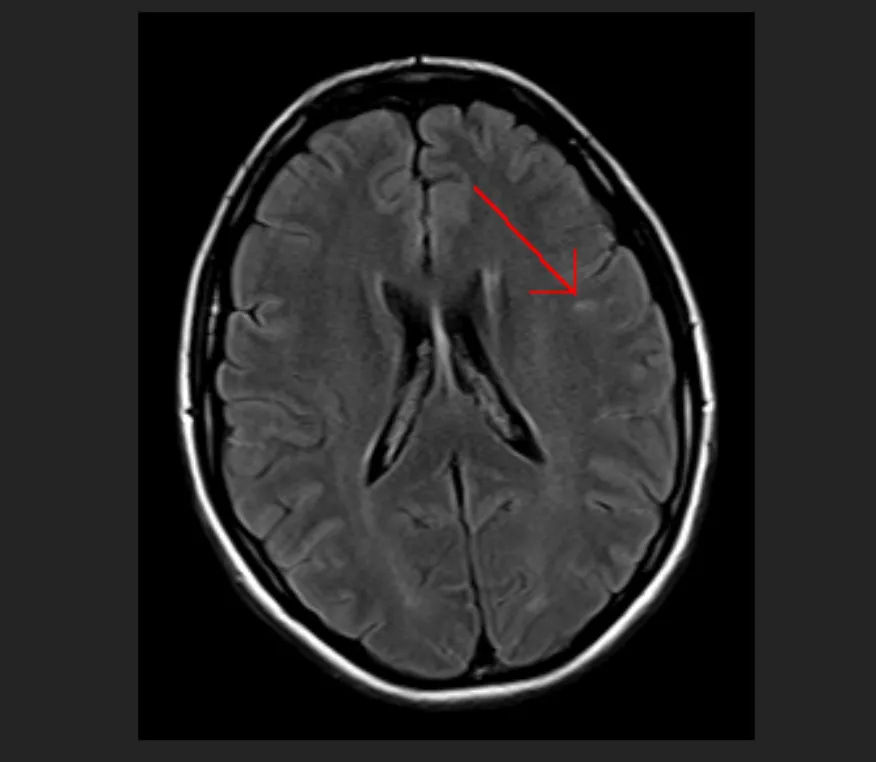
On my very first full-body MRI, the radiologist found 15 small white spots in my brain. I was told that 3 or 4 would be completely normal. But 15? That’s a lot.
At the time, the report called them “ischemic lesions.” When I showed the scan to a French neurologist, he called them “microangiopathy.” Two different words for what I was looking at. It isn’t always easy being a patient when even doctors don’t use the same language!
In fact, both terms point to the same problem, seen from two angles. “Ischemic” describes the damage: areas of brain tissue that didn’t get enough blood flow. “Microangiopathy,” known in the US as cerebral small vessel disease, names the cause: the tiny blood vessels that should be supplying those areas.
MRI slice (FLAIR sequence) of my brain in 2022. The arrow points to one of the white matter hyperintensities. The other lesions appear on different slices.
What Exactly Is It?
Cerebral small vessel disease (doctors also call it cerebral microangiopathy) affects the tiny arteries that supply blood to the deep parts of the brain. Their walls thicken and stiffen, the space for blood flow narrows, and the barrier that protects the brain becomes leaky. Plasma seeps into the surrounding tissue, causing swelling and inflammation, while the brain cells get less oxygen. On an MRI, these areas show up as small white spots called white matter hyperintensities. Over time, they’re linked to a higher risk of cognitive decline, balance problems, and stroke.
Where Do These Lesions Come From?
The main known risk factors are high blood pressure (even mildly elevated), vascular aging, poor blood sugar control and insulin resistance, chronic inflammation, high LDL cholesterol, elevated homocysteine, sleep apnea, smoking, and sometimes migraines.
In my case, most of these just don’t apply. I’ve never smoked. My LDL isn’t high, and neither is my homocysteine. No migraines, no sleep apnea, no high blood pressure, no blood sugar issues or insulin resistance.
One marker did catch my attention, though: my hs-CRP (high-sensitivity C-reactive protein, a marker of inflammation) consistently sits around 1 mg/L. Nothing alarming, but it points to chronic low-grade inflammation, the kind that works silently, year after year.
That left one last, lesser-known factor: repeated exposure to high altitude. Studies of mountaineers who climbed extremely high peaks, and of pilots regularly exposed to low atmospheric pressure, show more white matter hyperintensities. Low oxygen and low pressure weaken the barrier that protects the brain, and repeated exposure seems to matter most. And in less than ten years, I climbed 45 peaks above 13,000 feet (4,000 meters). Low-grade inflammation and altitude: those are most likely the two factors behind my case.
I had no symptoms. None. But I had no intention of letting these lesions settle in.
A neurology professor told me: “Ma’am, I’m a professor of neurology. I know this subject well. There’s nothing to be done.”
I answered: “Sir, I’m not a professor of neurology. I know nothing about it. So I’m coming in with a completely open mind, and I’m going to learn.”
I haven’t told you about this until now. First, because I didn’t want to worry anyone. Second, because I wanted to see whether my efforts would pay off.

August 2025: Three Years Later (MRI done as part of my yearly longevity evaluation at the YEARS CLINIC in Berlin)
The number of lesions had dropped to 11. Not bad for a condition considered irreversible. But skeptics might say: “That’s just a reading error. Let’s see if the trend holds.”
May 2026: Just Nine Months After the 2025 MRI (MRI done as part of my yearly longevity evaluation at the YEARS CLINIC in Berlin)
I was down to 9.
Can you believe it? From 15 to 9 in four years. That’s not a reading error, and it’s not luck. The trend is clear. My goal is to be down by 2 more next year.
The Meeting Last Week
Last week, I met with Dr. Jordan from the Regenesis HQ in Los Angeles, who looks 15 years younger than his chronological age!
He reviewed my last two MRIs in detail. He spent more than an hour on them and took the time to walk me through everything. He was surprised and genuinely congratulated me. Then came the question: “So what did you do?”
The protocol that follows, reserved for my loyal subscribers, covers everything I did.
And here’s the kicker: this protocol also had an impact on a second condition, which I’ll cover in an upcoming article. Again, a dramatic improvement.