

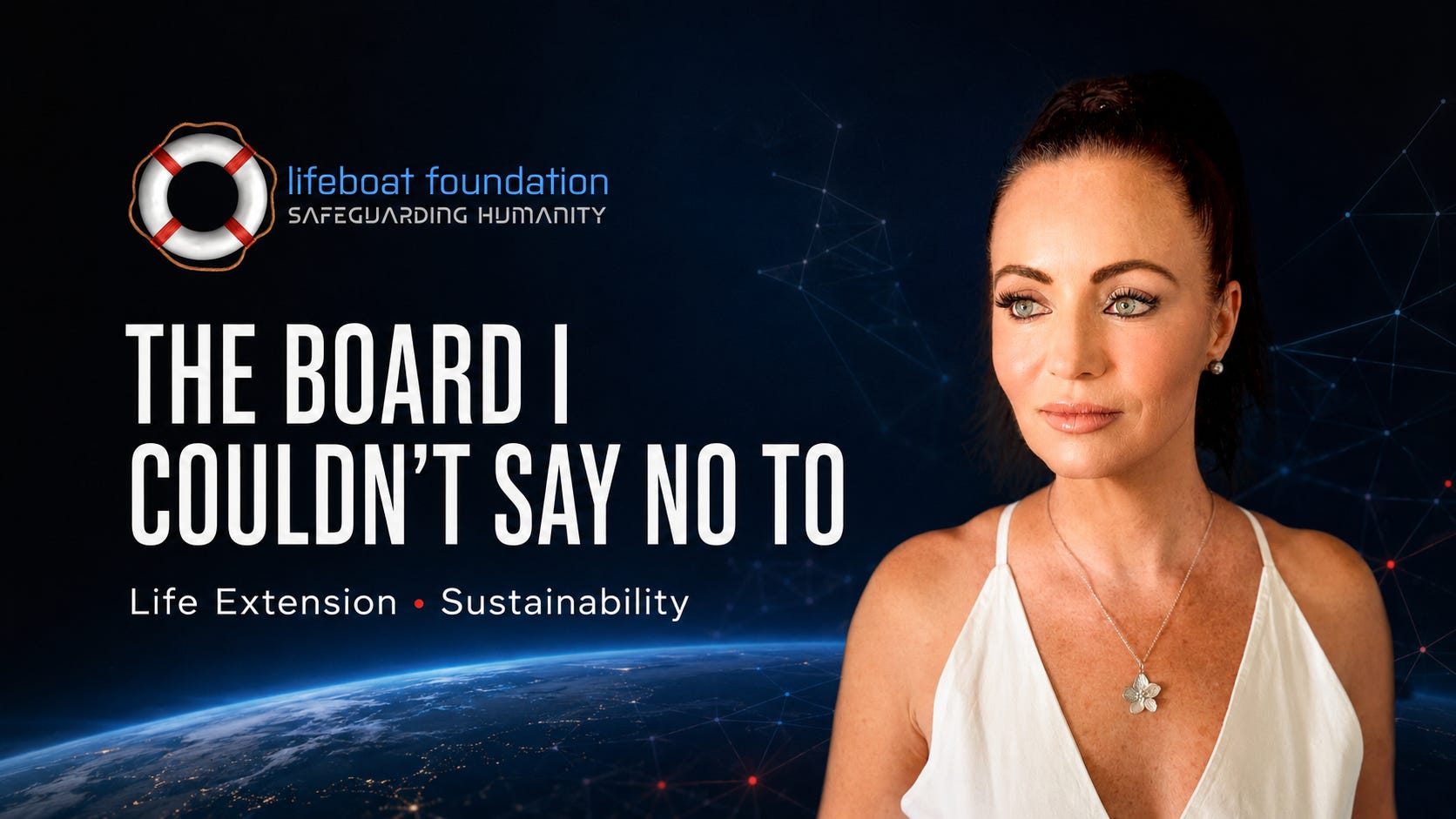
By Valérie Orsoni — Biohacker & Longevity Expert
Valérie Orsoni is a biohacker, author of 56 books, and founder of biohacker.fr. She has been tracking her biology through N=1 self-experimentation protocols since 1998. She is recently completed her Stanford Genetics Longevity Research certification program and is currently enrolled in the Stanford Medicine nutrition science program. She was named in the Top 50 Longevity Leaders by Life Spanning magazine and is currently the #1 on the Longevity Cup Leaderboard (chronological age -23 years).
I usually refuse to join boards.
I receive invitations regularly, and most of the time, I say no.
Not because I am uninterested or unwilling to contribute, but because I have learned that saying yes to everything eventually means having no time left for yourself.
I may be good at multitasking, but I also need time off. Time for my private life. Time to think. Time to do absolutely nothing.
We tend to fear empty space in our schedules. We fill every available hour, as though constantly being busy were proof that we matter. I know this pattern very well. I have worked hard to stop living in permanent “go, go, go” mode and to learn how to slow down without feeling guilty about it.
So today, I protect my time carefully.
But when the Lifeboat Foundation invited me to join its Life Extension Board, I could not say no.
And, in the end, I didn’t join just one board. I joined three:
The Life Extension Board
The Business Board
The Sustainability Board
Three subjects that may appear separate, but that I believe are deeply interconnected.
What would be the value of radically extending human life if we failed to preserve a habitable planet? How can scientific breakthroughs reach people without viable businesses capable of developing, financing and distributing them? And what is longevity worth if the technologies created to improve our lives ultimately threaten humanity itself?
These are not abstract questions anymore.
Safeguarding humanity
The Lifeboat Foundation is a nonprofit, nongovernmental organization whose mission is to encourage scientific progress while helping humanity prepare for existential risks and the possible misuse of increasingly powerful technologies.
That includes artificial intelligence, genetic engineering, nanotechnology, biotechnology and robotics, but also pandemics, asteroid impacts, environmental collapse and other threats capable of affecting civilization on a global scale.

The organization does not take the position that technology is inherently dangerous. Quite the opposite: technology may be our most powerful tool for improving and protecting human life.
But increasingly powerful tools require increasingly serious foresight.
The same scientific advances that can cure disease, regenerate tissue, extend healthy lifespan or solve environmental problems can also create risks when they are developed carelessly, released prematurely or placed in the wrong hands.
The Lifeboat Foundation explores defensive strategies ranging from improved methods for combating viruses to safeguards surrounding nanotechnology, artificial intelligence and other emerging fields. It even considers long-term resilience solutions such as self-sustaining space settlements, should our defenses on Earth ever fail.
Some of those ideas may sound futuristic. In 2010, The New York Times introduced the organization through its work on threats involving artificial intelligence, nanotechnology, black holes and other scenarios that, at the time, probably seemed very remote.

Sixteen years later, conversations about uncontrolled AI, engineered pathogens, climate instability and technological misuse no longer feel like science fiction.
They feel urgent.
The minds around the table
Another reason I accepted is the extraordinary range of people involved.
The Lifeboat Foundation’s advisory network includes scientists, physicians, economists, entrepreneurs, environmental experts, futurists, ethicists and technology leaders from around the world.
On the Life Extension Board, I join figures such as longevity researchers Aubrey de Grey, Nir Barzilai, Matt Kaeberlein, Brian Kennedy and Morgan Levine, as well as futurist and inventor Ray Kurzweil. The official board also includes many other researchers, physicians and innovators working on the biology and technology of human longevity. See the Lifeboat Foundation advisory boards.
The Business Board includes economist and technology scholar Erik Brynjolfsson, among many entrepreneurs, investors and leaders examining how ambitious scientific solutions can become economically viable.

The Sustainability Board includes oceanographer and explorer Sylvia Earle, environmental advocate and actor Ed Begley Jr., former NASA chief scientist Dennis Bushnell and paleontologist and conservationist Louise Leakey.
This diversity matters. No single discipline can address the scale of the challenges ahead.
Scientists need entrepreneurs. Entrepreneurs need ethicists. Longevity researchers need environmental experts. Technologists need people willing to ask not only, “Can we build it?” but also, “Should we build it, how should we protect it, and who might be affected if it goes wrong?”
Why these three boards make sense for me
The Life Extension Board is an obvious continuation of work I have pursued for decades.
I have been researching, testing and writing about longevity since long before the word became fashionable. My approach has always combined scientific evidence with real-life experimentation. I am interested not merely in adding years to life, but in extending the years during which we remain strong, lucid, mobile, curious and independent.
But longevity cannot exist in isolation.
That is why the Sustainability Board matters just as much to me. Human health depends on environmental health: the air we breathe, the water we drink, the quality of our food, the stability of our ecosystems and the resilience of the planet supporting us.

There is little point in adding decades to human lifespan if those decades are lived amid polluted air, contaminated water, collapsing food systems and increasingly unlivable environments.
And then there is the Business Board.
I have spent much of my life building companies and communities, turning ideas into programs and translating complex science into information people can actually use. Science cannot transform society if it remains confined to research papers, laboratories or small circles of experts. It needs responsible business models, communication, funding and execution.
This is where I believe I can contribute something specific: at the intersection of longevity science, entrepreneurship, public education and sustainability.
Saying yes to what matters
Joining an advisory board should never be about collecting another title for a biography.
For me, it has to mean contributing. Asking difficult questions. Sharing experience. Connecting people and ideas that might otherwise remain separated. Helping important science move from discussion toward action.
I will continue to say no to many invitations. I need to. Preserving time, peace of mind and room to think remains essential to the way I want to live.
But protecting your time does not mean withdrawing from the world.
It means saving your yes for the things that matter most.
The Lifeboat Foundation’s mission is, quite literally, to help safeguard humanity. At a moment when science is advancing faster than our collective ability to anticipate all its consequences, I believe that mission is too important to ignore.
So this time, I said yes.
Three times.

Valérie Orsoni
Biohacker since 1998 | Longevity Expert
University of Hartford Hall of Fame
Top 50 Longevity Leaders (by Lifespanning Magazine)
Explorer: Skied to the South Pole, Climbed 45 peaks over 16k ft
Instagram : Valerie Orsoni
My fave brands + super promo codes here ==> ValerieOrsoni.com
My made-in-the-usa, clean, no fillers supplement line ==> ZellNova
🎙 Life Summit— Berlin (29-30 mai 2026)
🎙 Corsica Biohacking — Corsica (6-13 juin 2026)
🎙 Biohackers World Conference — New York (juin 2026)
🎙 RAADFest— Sedona (4-6 septembre 2026)
🎙 HealthSpan Summit — Los Angeles (2–4 oct. 2026)
🎙 Reclaiming Health & Longevity Symposium — El Salvador (8–9 nov. 2026)
🎙 Biohackers World Conference — Miami (Jan. 2027)