


By Valérie Orsoni — Biohacker & Longevity Expert
Valérie Orsoni is a biohacker, author of 56 books, and founder of biohacker.fr. She has been tracking her biology through N=1 self-experimentation protocols since 1998. She is currently enrolled in Stanford Medicine’s longevity research certification program.
What the world’s most measured human teaches us about biomarkers, nutrition, autoimmune disease—and why the biggest health lessons often come from unexpected diagnoses.
Imagine spending approximately $2 million every year trying to become the healthiest human on Earth.
Every bite of food is measured.
Every workout is optimized.
Every hour of sleep is tracked.
Blood tests.
MRI scans.
CT scans.
DEXA scans.
Microbiome analyses.
Continuous glucose monitoring.
Wearables measuring everything from heart-rate variability to sleep architecture.
If anyone could detect disease early, you would expect it to be Bryan Johnson.
Which is exactly why his recent announcement surprised so many people.
“I have an autoimmune disease,” Johnson wrote on X. “My stomach is eating itself.” Despite years of unprecedented medical monitoring, he revealed that he has autoimmune gastritis—a disease in which the immune system slowly destroys the stomach’s acid-producing cells.
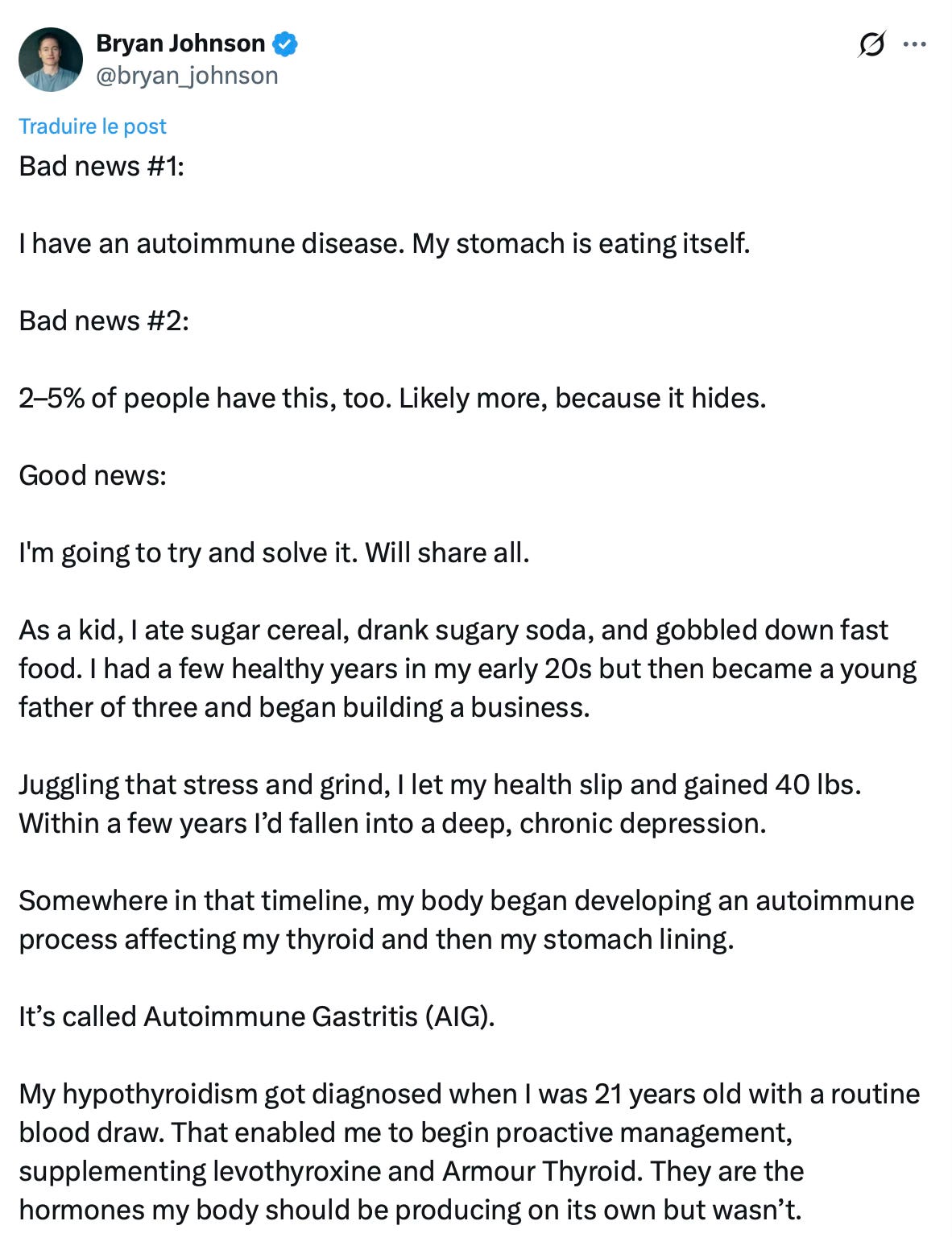
The first clue? Not pain. Not fatigue. Not dramatic symptoms.
Just one stubborn biomarker that refused to cooperate.
Ferritin.
For years, Johnson’s ferritin—a protein that reflects the body’s stored iron—stayed persistently low.
But his hemoglobin and hematocrit, the values doctors typically use to diagnose anemia, looked normal.
That combination made the problem easy to dismiss, again and again, because it didn’t fit the pattern anyone was trained to flag.
The body drains its iron reserves first to protect circulating hemoglobin, which means it’s entirely possible to be meaningfully iron deficient while every “standard” number still looks fine.
That single laboratory value eventually led physicians to test for anti-parietal cell antibodies (Johnson’s came back at 103 U/mL, well above the threshold that gives this test roughly 93% sensitivity and 98% specificity), then to a bi-directional endoscopy, and finally to biopsies that confirmed the diagnosis.
Most headlines focused on the disease—the striking image of a stomach “eating itself.” I think they’re missing the real story.
Because Bryan Johnson’s diagnosis isn’t primarily about Bryan Johnson.
It’s about every one of us.
It reminds us that longevity isn’t about finding the perfect protocol. It’s about learning how to listen when biology quietly tells us something isn’t right. And that may be the most valuable lesson of all.
Here are seven of them.
Lesson 1: A Trend Is Worth More Than Any Single Number
One of the things I’ve learned after decades of tracking my own biomarkers is that trends matter far more than isolated values. A single low ferritin reading is a data point. A ferritin that stays low, visit after visit, year after year, is a signal—and signals deserve a different kind of attention than noise.
Johnson’s ferritin didn’t dip once and recover. It stayed low, persistently, for years. That’s the pattern that should stop a clinician (or a self-tracker) in their tracks: not the number itself, but its refusal to move.
🧬 Biohacker’s Note A “normal” laboratory value isn’t necessarily optimal. But the opposite is also true. An abnormal value isn’t something to suppress without understanding why it’s abnormal. The number is often the messenger—not the problem itself.
Lesson 2: “Normal” Hemoglobin Can Hide an Iron Problem
This is the detail that let Johnson’s condition hide in plain sight for so long. Ferritin measures stored iron. Hemoglobin and hematocrit measure circulating iron. Because the body protects circulating hemoglobin at almost any cost, it will quietly deplete its reserves—ferritin—long before hemoglobin ever budges.
That means a person can be genuinely iron deficient, even heading toward anemia, while every test a routine physical orders comes back “fine.” Gastroenterologists who specialize in this condition now argue that anyone with persistently low ferritin, treated or not, deserves a closer look—not just a repeat prescription for iron pills.
Lesson 3: When a Biomarker Won’t Normalize, Get Curious—Not Anxious
When one biomarker refuses to normalize, I become curious—not anxious.
Anxiety makes people either obsess or avoid.
Curiosity makes people ask better questions: What else could explain this? What haven’t we tested? Who else should be looking at this data?
That distinction matters because autoimmune gastritis is, by every account from the physicians who study it, notoriously insidious.
It can stay silent for decades, sometimes announcing itself only through symptoms that seem to belong to a completely different system—fatigue, weakness, neurological complaints—rather than anything resembling a stomach problem.
A single strange lab value, followed patiently over time, is often the only early warning available.
Lesson 4: Autoimmune Diseases Rarely Travel Alone
Johnson also has autoimmune thyroid disease, and that’s not a coincidence.
Roughly a third to nearly half of people diagnosed with autoimmune gastritis also have autoimmune thyroiditis—a pairing common enough that some clinicians now describe it as its own syndrome. The same goes for other autoimmune conditions: type 1 diabetes, Addison’s disease, and others cluster together more often than chance would predict.
🔬 Biohacker’s Note Autoimmune diseases often travel together. If someone is diagnosed with autoimmune gastritis, physicians commonly consider evaluating for other autoimmune conditions such as autoimmune thyroid disease, depending on the clinical context. One diagnosis is often a reason to look for its neighbors—not a reason to stop looking.
Lesson 5: Blood Work Can Point the Way, But It Can’t Close the Case
I’ve changed my protocols countless times over the past forty years. That’s not inconsistency. That’s what following evidence looks like. And the evidence, in Johnson’s case, eventually required more than a blood draw.
Ferritin and antibody tests can raise suspicion, but the gold standard for diagnosing autoimmune gastritis is still an upper endoscopy with biopsies of the stomach lining, taken from more than one location. No wearable, no at-home panel, and no amount of quantified-self dashboarding replaces that step.
Biomarkers are a compass.
They tell you where to look.
They rarely tell you, on their own, exactly what you’ll find.
🧬 Biohacker’s Note Autoimmune gastritis carries a real long-term cost beyond iron deficiency: it disrupts vitamin B12 absorption (raising the risk of pernicious anemia) and is linked to a higher risk of gastric neuroendocrine tumors and stomach adenocarcinoma. This is why ongoing endoscopic surveillance—not just iron repletion—is part of long-term management.
Lesson 6: Even the Most “Optimized” People Skip Routine Screening
Here’s a detail worth sitting with: Johnson mentioned he was “48 years old and overdue” for the colonoscopy that was part of his eventual workup.
Guidelines have recommended colon cancer screening starting at age 45 since 2021—a full five years earlier than the previous standard.
Even someone spending millions of dollars a year on biomarker surveillance can still fall through a gap created by a guideline change he simply hadn’t registered.
Myth vs. Reality
MYTH: Low ferritin simply means you need more iron.
REALITY: Sometimes. Sometimes it’s blood loss. Sometimes it’s poor absorption. Sometimes it’s celiac disease. Sometimes it’s autoimmune gastritis. Sometimes it’s something entirely different. Always ask why.
The lesson isn’t that Johnson made a mistake.
It’s that optimization and routine preventive care are not the same project, and one doesn’t automatically cover for the other.
The most sophisticated wearable in the world won’t remind you that a screening age changed five years ago.
Lesson 7: Be Careful With the Story You Tell About Your Own Body
Johnson has publicly speculated that his condition might trace back to a childhood diet heavy in fast food, sugary cereal, and soda.
It’s a compelling narrative—cause and effect, wrapped up neatly.
But the gastroenterologists and pathologists who study this disease have been candid that there’s no specific evidence linking early diet to autoimmune gastritis; one called the theory “highly speculative.” The actual cause remains unknown, likely some combination of genetic susceptibility, environmental triggers, and chronic inflammation.

I’ve always believed in food diversity. Reading about Bryan’s diagnosis made me even more convinced that dietary monotony deserves much more scientific attention. Notice the nuance: I’m not claiming it caused his disease. I’m saying it made me reflect on a broader scientific question. That’s exactly how a scientist thinks—curious about the pattern, honest about what’s actually been proven.
Self-trackers are especially prone to this trap, because we have so much of our own data that we can always find a variable to blame. The discipline isn’t in refusing to hypothesize. It’s in being willing to say “I don’t actually know” out loud, even about your own body.
What This Story Changed For Me
Not what I already do. What Bryan Johnson’s diagnosis made me think about.
It made me think about how much of medicine still depends on someone—a patient, a doctor, a pathologist—refusing to let an unexplained number go.
Johnson had extraordinary resources on his side.
Most people don’t have a team combing through years of lab trends.
And yet even with all of that, the diagnosis still took years, because the disease is genuinely hard to catch, and because “normal” hemoglobin is a reassuring number that can quietly mislead.
It also made me think about what happens after the diagnosis.
There’s no cure for autoimmune gastritis.
Current treatment mostly means correcting the iron deficiency, watching for vitamin B12 deficiency, and undergoing regular surveillance for the cancers associated with the condition—which is precisely why Johnson says his team is now looking at experimental approaches, CAR-T therapy among them, still early and unproven for this disease.
As one researcher who studies the condition put it, no one can fully “biohack” their way out of disease, or out of death. Measurement extends the runway. It doesn’t cancel the flight.
A Checklist Worth Keeping
If ferritin runs persistently low—even once “corrected” with supplementation—ask whether the underlying cause was ever actually identified, not just treated.
Don’t let normal hemoglobin or hematocrit talk you out of investigating low ferritin further. They measure different things.
If you have one autoimmune diagnosis, ask your physician whether screening for related autoimmune conditions makes sense for you.
Know your screening ages. Colon cancer screening now starts at 45 for most people—not 50.
Treat an unexplained, persistent lab abnormality as a question, not a nuisance to normalize away.
Be skeptical of tidy causal stories about your own body, especially the ones you tell yourself.
Your body almost never starts by screaming.
It starts by whispering.
The question is whether you’re listening.
ps : Interestingly, this announcement also comes as Bryan is launching a premium longevity concierge service. Whether the timing is purely coincidental or simply reflects a particularly eventful period in his journey is impossible to know and I will let you (and the future few months) be the judge of it.
References after my signature.
Valérie Orsoni
Biohacker since 1998 | Longevity Expert
Instagram : Valerie Orsoni
My fave brands + super promo codes here ==> ValerieOrsoni.com
My made-in-the-usa, clean, no fillers supplement line ==> ZellNova
🎙 Life Summit— Berlin (29-30 mai 2026)
🎙 Corsica Biohacking — Corsica (6-13 juin 2026)
🎙 Biohackers World Conference — New York (juin 2026)
🎙 RAADFest— Sedona (4-6 septembre 2026)
🎙 Healthspan Summit — Los Angeles (2–4 oct. 2026)
🎙 Reclaiming Health & Longevity Symposium — El Salvador (8–9 nov. 2026)
Disclaimer: This article reflects one individual’s personal experience, research, and interpretation of scientific information. It is not medical advice and should not be used as a substitute for professional diagnosis or treatment. Health conditions—whether metabolic, hormonal, digestive, neurological, cardiovascular, immune-related, or otherwise—can vary widely in severity and may require urgent or specialized medical care. Always seek advice from qualified healthcare professionals before beginning, changing, or discontinuing any medication, supplement, lifestyle protocol, or therapeutic approach. Personal experiences described here, including mild or atypical presentations, are not representative of all clinical situations or of serious or acute medical conditions requiring immediate attention.
References
Todd, S. “Bryan Johnson’s diagnosis shines light on hard-to-detect disease.” STAT News, July 8, 2026. statnews.com
“How did Bryan Johnson end up with an autoimmune disease?” Northeastern Global News, July 6, 2026. news.northeastern.edu
“Autoimmune Gastritis: All about the ‘incurable’ condition Bryan Johnson is diagnosed with.” The Week, July 7, 2026. theweek.in
Lenti, M.V., et al. “Autoimmune gastritis.” PMC, National Institutes of Health. pmc.ncbi.nlm.nih.gov/articles/PMC5065578
“Autoimmune gastritis, with or without pernicious anemia: epidemiology, risk factors, and clinical management.” PMC. pmc.ncbi.nlm.nih.gov/articles/PMC8414617
“Relevance of pepsinogen, gastrin, and endoscopic atrophy in the diagnosis of autoimmune gastritis.” PMC. pmc.ncbi.nlm.nih.gov/articles/PMC8913737
“Iron deficiency workup reveals high incidence of autoimmune gastritis with parietal cell antibody as reliable screening test.” ScienceDirect. sciencedirect.com/science/article/abs/pii/S0037196318300532
“Frontiers | Autoimmune gastritis: a comprehensive review of pathophysiology, risk stratification, and management.” Frontiers in Immunology, 2026. frontiersin.org
Interesting. I think they've provided the information. It depends on how much you can follow and what results you get, because everyone has different levels of discipline and will achieve different results.
Super thoughtful but honestly I always thought he was doing a little too much