

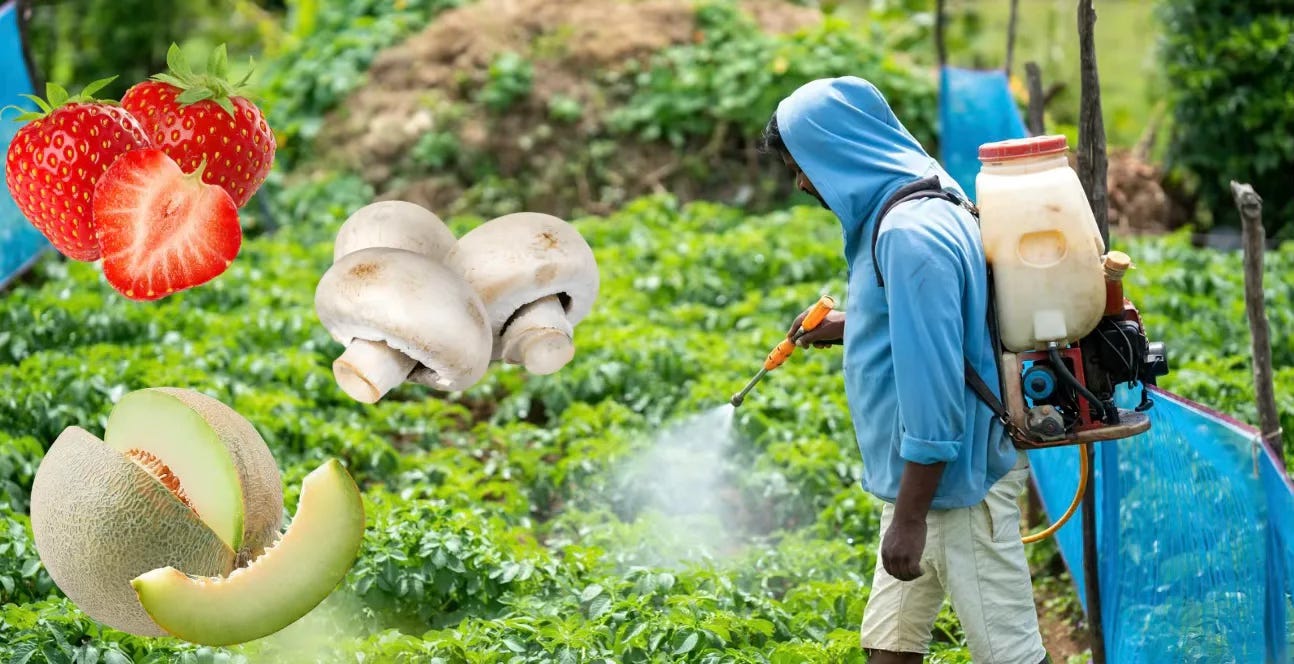
Every year, the Environmental Working Group (EWG) analyzes pesticide residue data from the USDA and FDA — testing fruits and vegetables after washing, sometimes peeling, preparing them just as you would at home.
The goal is simple: figure out what's still on your food after you've done everything right.
In 2026, they tested 54,344 samples across 47 fruits and vegetables, screening for 264 different substances.
This is the primary source.
Everything below comes directly from that report.

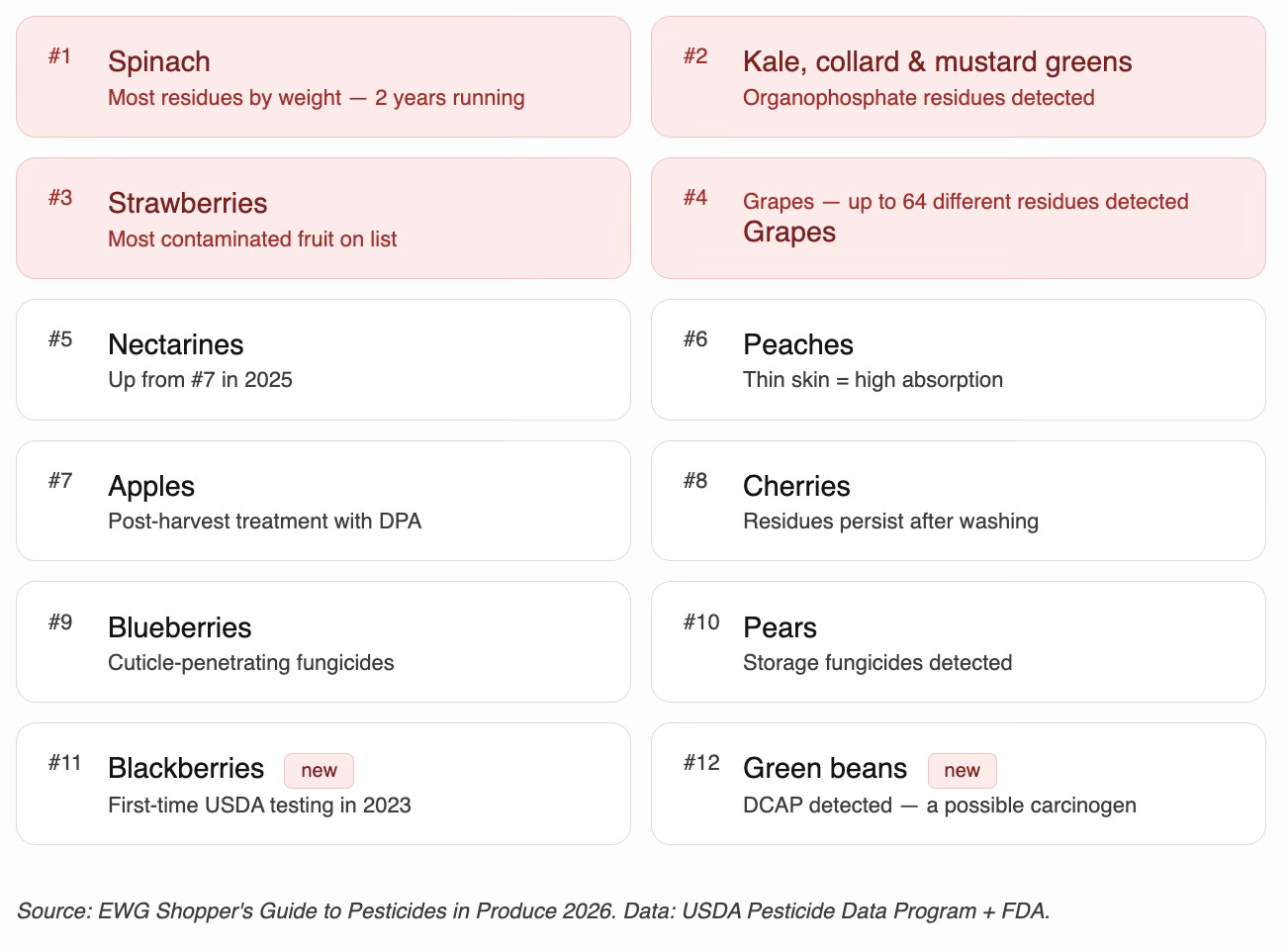
The 2026 Dirty Dozen
Spinach holds the #1 spot for the second year in a row — more pesticide residues by weight than any other produce tested.
Two new entries this year: blackberries (tested by USDA for the first time in 2023) and green beans.
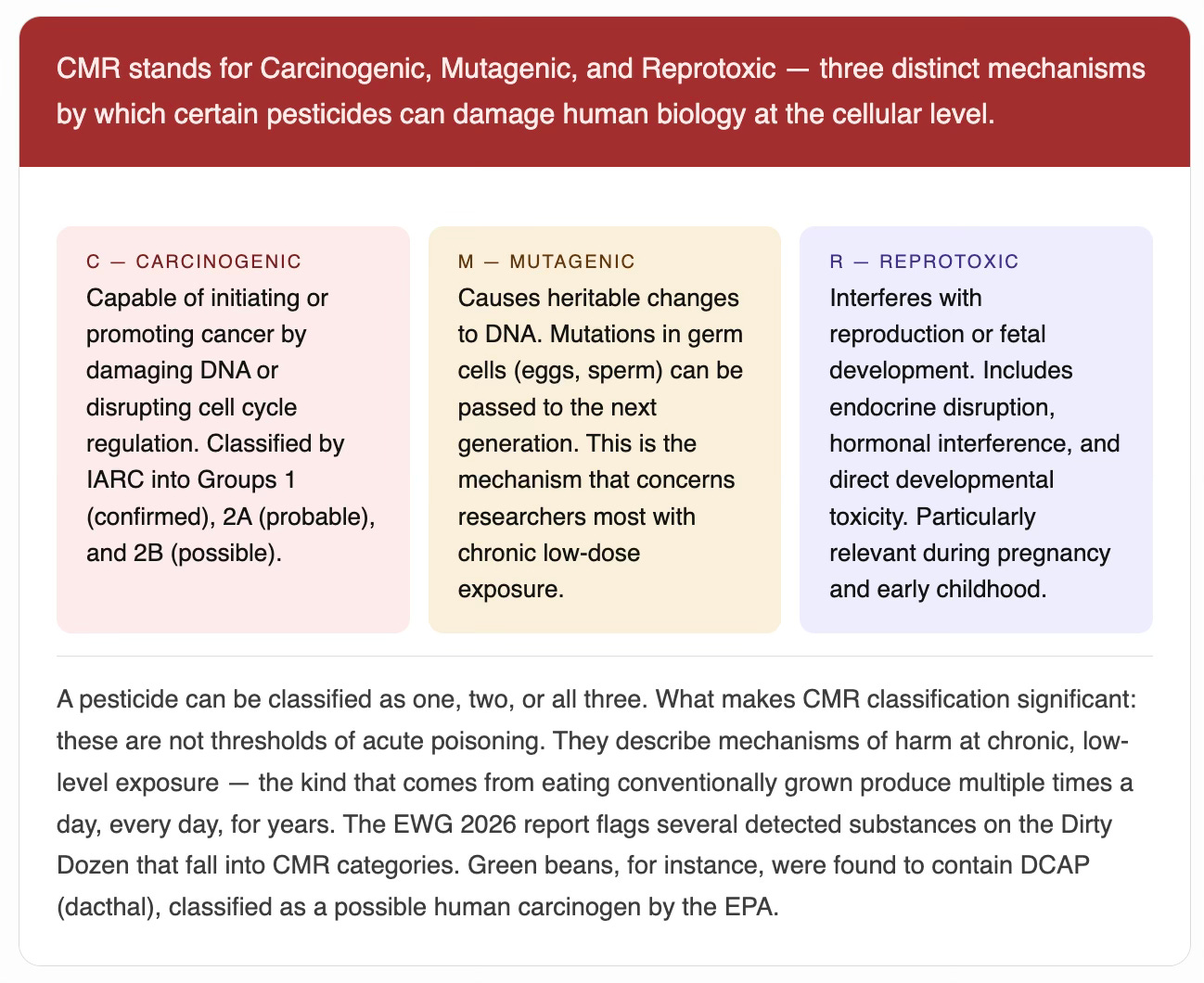
What are CMR pesticides — and why do they matter more than residue counts?
The Dirty Dozen rankings are based on residue frequency and volume.
That’s useful. But in toxicology, the category of a substance matters as much as the quantity.
The most important classification to understand is CMR.
The problem the Dirty Dozen doesn’t capture: oxalates
Spinach and kale top the 2026 list — but pesticide load is not their only issue. Both are among the highest oxalate-containing plants in existence.
Oxalates are natural defense compounds produced by the plant. In susceptible individuals — those with altered gut microbiome, intestinal hyperpermeability, or genetic predisposition — chronic excess intake can contribute to kidney stones, joint pain, systemic inflammation, and urinary tract irritation.
Raw consumption concentrates the problem: cooking partially reduces oxalate content.
The daily giant raw spinach smoothie was one of the worst “healthy” habits of the 2010s.
The EWG data in 2026 now adds pesticide load on top of that existing concern.
My N=1 personal data
Since reducing my raw spinach and kale intake, I’ve tracked improvement in CRP markers and reduced post-training joint discomfort.
Tracked via continuous monitoring, confirmed across multiple testing cycles. Correlation isn’t causation — but combined with the 2026 EWG data, the signal is consistent enough to act on.
These foods still have real nutritional value
This is not an argument to stop eating vegetables. Spinach delivers folate, magnesium, lutein, nitrates for nitric oxide production, and vitamin K. Strawberries provide anthocyanins and vitamin C. Grapes contain resveratrol. The point is not that these foods are bad — it’s that dose, source, and preparation matter enormously. A food can be nutritionally valuable and problematic in excess or when sourced conventionally.
What the Clean Fifteen tells you
The EWG also releases a Clean Fifteen — the 15 fruits and vegetables with the lowest pesticide residue loads, even in conventional form.
These are worth knowing: avocados, sweet corn, pineapple, onions, papaya, frozen sweet peas, asparagus, honeydew melon, kiwi, cabbage, mushrooms, mango, sweet potatoes, watermelon, and carrots. Building variety around these — while going organic on the Dirty Dozen — is a practical, cost-effective protocol.
Organic everything is ideal.
Organic everything is also not always realistic.
What I recommend — practically
1 Go organic for the top 4 on the list. Spinach, kale, strawberries, and grapes are the highest priority. This is where the residue load and CMR risk intersects most clearly with daily consumption frequency.
2 Cook spinach and kale instead of eating them raw. Cooking reduces oxalate content partially and breaks down some water-soluble residues. The raw green smoothie daily habit is not a biohack — it’s a liability if your sourcing isn’t clean.
3 Stop eating the same “superfoods” every single day. Rotation matters. Thirty-plus different plants per week is a meaningful target — for microbiome diversity and to avoid chronic accumulation of the same residue profiles.
4 Build your base around the Clean Fifteen. Avocados, asparagus, onions, mushrooms, sweet potatoes, cabbage, kiwi — these are nutritionally dense, low-residue, and almost never discussed. Use them as the foundation.
5 Washing reduces but does not eliminate residues. The EWG data is collected after washing. That number is what remains. Peeling helps for some fruits. For leafy greens, it’s not an option — sourcing is the only real lever.
The bottom line
The EWG 2026 report is a primary data source — 54,344 samples, 264 substances, prepared the way you’d actually eat them. Spinach and kale at the top is not a fringe finding. It has been consistent for years.
The CMR angle is the piece most media coverage misses. Residue count is one metric. The mechanism of harm — carcinogenic, mutagenic, reprotoxic — is a different and more actionable one. That’s the question to ask about everything on this list.
Real biohacking is not about finding the perfect superfood. It’s about reading the actual data — and updating your protocol when the data changes.
Let’s keep going! Forza!
Valérie Orsoni
Biohacker since 1998 | Longevity Expert
Instagram : @valerieorsoni
My fave brands + super promo codes here ==> ValerieOrsoni.com
My made-in-the-usa, clean, no fillers supplement line ==> ZellNova
🎙 Life Summit— Berlin (29-30 mai 2026)
🎙 Corsica Biohacking — Corsica (6-13 juin 2026)
🎙 Biohackers World Conference — New York (juin 2026)
🎙 RAADFest— Sedona (4-6 septembre 2026)
🎙 HealthSpan Summit — Los Angeles (2–4 oct. 2026)
🎙 Reclaiming Health & Longevity Symposium — El Salvador (8–9 nov. 2026)