

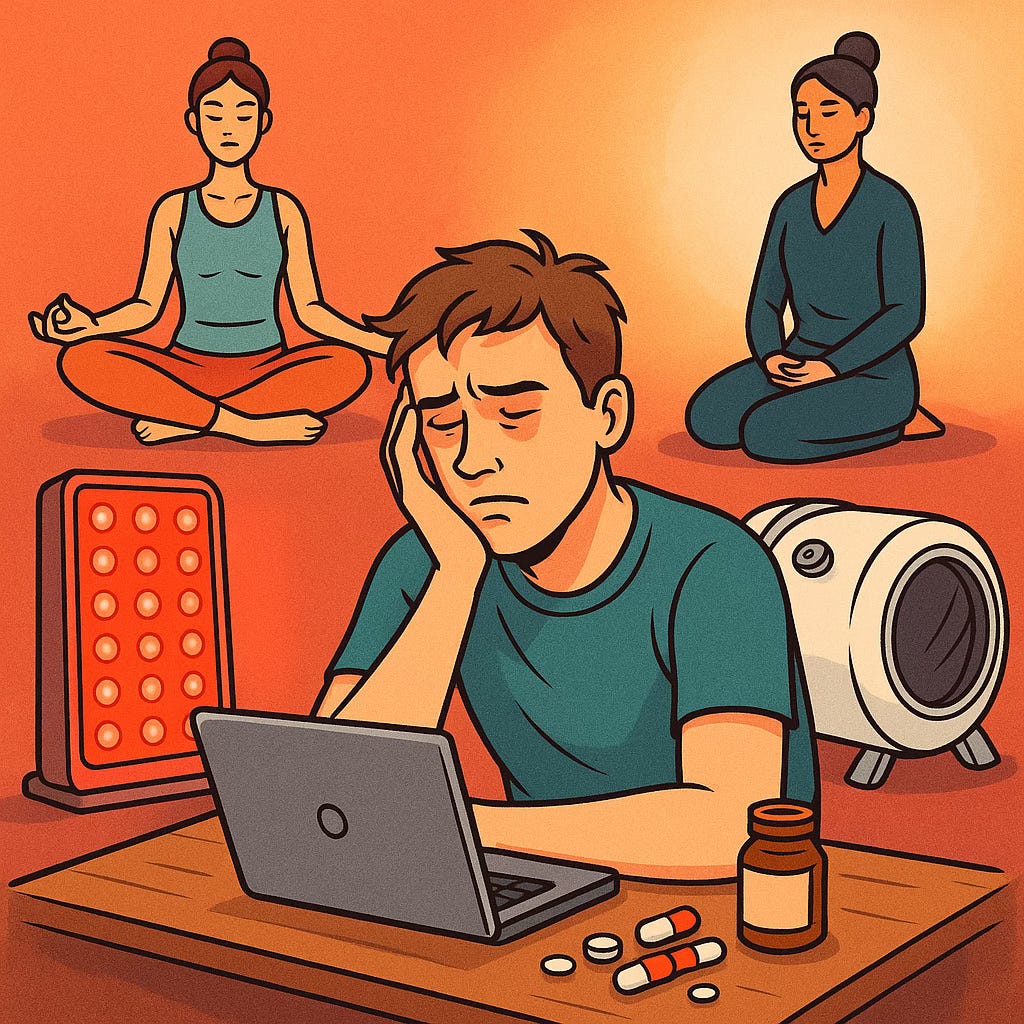
Understanding Biohacker Burnout
We entered this world of biohacking with a promise: take control of your biology, optimize your health, and unlock your full potential.
Yet somewhere between the morning peptide injections, the third round of functional testing, and meticulously tracking our twentieth biomarker, many of us hit an unexpected wall.
Biohacker burnout is real, and it’s more common than we admit.
After years of working with clients pursuing advanced optimization protocols and navigating my own journey through high-level biohacking, I’ve witnessed a pattern that contradicts everything we’re told about “health optimization.” The very practices meant to enhance our vitality can become a source of chronic stress, decision fatigue, and paradoxically, declining health outcomes.
The Symptoms: When More Becomes Less
Biohacker burnout doesn’t announce itself with a dramatic crash. It creeps in slowly, disguised as dedication:
Decision Fatigue Around Health Choices You find yourself paralyzed at breakfast, mentally calculating the impact of every food choice on your blood glucose, inflammatory markers, and mitochondrial function. The joy of eating has been replaced by an exhausting cost-benefit analysis at every meal.
Supplement Stack Overwhelm Your morning routine has expanded from 5 minutes to 45 minutes. You have multiple supplement protocols running simultaneously—some for longevity, others for detoxification, several for cognitive enhancement. You’re not entirely sure what’s working anymore, but you’re afraid to stop anything.
Testing Obsession and Metric Anxiety Each new test result triggers hours of research and protocol adjustments. Your PACE score went up by 0.02? Panic. Your hs-CRP increased slightly? Complete protocol overhaul. You’ve lost the ability to trust how you actually feel, deferring entirely to numbers that fluctuate naturally.
Social Isolation You’ve declined dinner invitations because the restaurant doesn’t accommodate your SIBO protocol. You can’t travel without bringing a cooler of specific foods and your entire supplement arsenal. Your non-biohacker friends have stopped inviting you to events.
The Optimization Treadmill There’s always another protocol to try, another emerging therapy, another biomarker to optimize. You’ve achieved remarkable improvements—your telomeres have lengthened, your biological age has decreased—yet you feel more exhausted than before you started.
The Root Cause: When Self-Improvement Becomes Self-Surveillance
The problem isn’t biohacking itself. The problem is the psychological shift that happens when health optimization transforms from an empowering practice into a rigid system of self-surveillance.
The Perfectionism Trap Biohacking attracts high-achievers, and high-achievers often struggle with perfectionism. We apply the same intensity we use in our careers to our biology, forgetting that the human body isn’t a startup that can be growth-hacked into exponential returns.
The irony? Perfectionism itself is inflammatory. The chronic stress of trying to achieve perfect health markers creates the very physiological dysfunction we’re trying to avoid.
The Loss of Intuition We’ve become so data-dependent that we’ve lost touch with somatic intelligence. Hunger cues, fatigue signals, stress responses—all are overridden by what the CGM or HRV monitor says we should be feeling.
I learned this the hard way during high-altitude climbing expeditions. My laboratory fitness measurements were ok, not stellar, my Oura ring put me in the red on pretty much all markers, yet my real-world endurance capability told a different story and I was super fast. The disconnect between data and lived experience is often where burnout begins.
The Comparison Epidemic Social media has amplified biohacker burnout exponentially. We see curated glimpses of others’ protocols and results, creating an impossible standard.
Someone reversed their biological age by 15 years? Now your 8-year reversal feels inadequate.
The Science Behind the Stress
Here’s what’s happening physiologically when biohacking becomes counterproductive:
HPA Axis Dysregulation Constant vigilance about health creates chronic low-grade stress. Your hypothalamic-pituitary-adrenal axis remains in a state of heightened alert, elevating cortisol and contributing to the exact inflammatory pathways you’re trying to suppress through supplements and protocols.
Orthorexia Nervosa While not officially recognized in all diagnostic manuals, orthorexia—an unhealthy obsession with healthy eating—shares psychological patterns with other eating disorders. The difference is that it’s often celebrated in biohacking communities as “discipline.”
Decision Fatigue and Glucose Dysregulation Making dozens of health-related decisions daily depletes cognitive resources and can actually impair glucose regulation through stress pathways—regardless of your “perfect” diet.
The Path Forward: Sustainable Optimization
Recovery from biohacker burnout requires a fundamental shift in approach:
1. Establish Non-Negotiable Baselines
Instead of chasing optimal, identify your essential protocols—the 20% of interventions providing 80% of benefits. For most people, this includes:
Quality sleep (non-negotiable 7-9 hours)
Whole foods nutrition without excessive restriction
Regular movement you actually enjoy
Stress management practices
Basic supplementation addressing genuine deficiencies
Everything else becomes experimental and temporary, not permanent additions to an ever-growing stack.
2. Implement Protocol Cycles
Your body responds best to periodization, not constant intervention. Consider:
Testing quarterly rather than monthly (unless actively troubleshooting)
Cycling advanced protocols (3 months on, 1 month off)
Seasonal approaches rather than year-round optimization
Scheduled “protocol holidays” where you maintain only core practices
I’ve seen remarkable improvements when clients implement supplement cycling strategies rather than running everything continuously. The body needs breaks from constant intervention.
3. Reconnect With Somatic Awareness
Before checking your HRV score, ask: How do I actually feel today?
Practice spending time without tracking devices.
Notice hunger, satiety, energy levels, and stress without immediate data consultation.
This isn’t anti-science; it’s recognizing that subjective experience provides valuable information that data alone cannot capture.
4. Define Success Beyond Biomarkers
What’s the actual goal? Living to 120 but being too exhausted and isolated to enjoy any of it? Or building sustainable vitality that allows you to fully engage with life?
Sometimes the best optimization is stepping back from optimization.
5. Build a Supportive Community
Surround yourself with people who understand biohacking but also value balance.
Be honest about struggles, not just successes. The vulnerability to admit “I’m overwhelmed by my protocols” is often the beginning of genuine healing.
My Personal Reckoning
I’ll be transparent: I’ve been there. Pursuing a PACE score under 0.69 while managing SIBO dietary restrictions, implementing mycotoxin detoxification protocols, creating content about advanced optimization strategies, and maintaining client consultations—I hit a point where the optimization had become the stressor.
The breakthrough came when I acknowledged that the rigidity itself was inflammatory.
My body responded better to a slightly less “perfect” protocol implemented with ease than to an optimal protocol executed with chronic stress.
The New Paradigm: Biohacking 2.0
The next evolution of biohacking isn’t about adding more interventions—it’s about finding the minimum effective dose that creates maximum sustainable benefit.
It’s recognizing that psychological wellbeing, social connection, joy, and play are not obstacles to optimization but essential components of it.
It’s understanding that your HRV, PACE score, and telomere length are means to an end, not the end itself. The goal isn’t perfect biomarkers; it’s a vital, engaged, meaningful life.
Oh, and don’t forget no marker (yet) can measure JOY OF LIFE, the “joie de vivre” as we say in French.
Practical Recovery Protocol
If you’re experiencing biohacker burnout, try this 30-day reset:
Week 1: Audit and Simplify List every supplement, protocol, and tracking habit. Identify the top 5 that genuinely make you feel better. Pause everything else.
Week 2: Reintroduce Flexibility Eat one meal without tracking or restriction. Schedule one social event without your full protocol setup. Notice what happens—probably nothing catastrophic.
Week 3: Focus on Fundamentals Optimize sleep, stress management, and joyful movement. Track only one metric: how you feel on a simple 1-10 scale each evening.
Week 4: Reassess With fresh perspective, selectively reintroduce practices that provided genuine benefit without excessive burden.
The Bottom Line
Biohacking should enhance life, not consume it.
When optimization becomes a full-time job that depletes rather than energizes, we’ve lost the plot.
The most advanced biohack? Learning to trust that your body is resilient, adaptive, and capable of thriving without constant intervention. Sometimes the best protocol is simplicity itself.
True optimization includes the wisdom to know when to step back, the courage to prioritize wellbeing over perfect biomarkers, and the self-compassion to recognize that you are not a science experiment—you’re a human being deserving of ease, joy, and sustainable vitality.
Have you experienced biohacker burnout? What helped you find balance? Share your story in the comments—your experience might be exactly what someone else needs to hear.
Valérie Orsoni
Biohacker since 1998 | Longevity Expert
Instagram : @valerieorsoni
My fave brands + super promo codes here ==> ValerieOrsoni.com
🎙 Longevity Leadership Conference – Verizon Innovation Lab, Los Angeles - Mar 18–19, 2026)
🎤 Biohackers World Conference & Expo, Los Angeles (Mars 28-29, 2026)
🎙 HealthSpan Summit, Los Angeles (Oct 2–4, 2026)
🎙 Reclaiming Health & Longevity Symposium (El Salvador, Nov 8–9, 2026)
Great read! Needed to see this!
This was very insightful! Thank you for this!