

By Valérie Orsoni — Biohacker & Longevity Expert
Valérie Orsoni is a biohacker, author of 56 books, and founder of biohacker.fr. She has been tracking her biology through N=1 self-experimentation protocols since 1998. She has completed a Stanford Genetics Longevity Research certificate a AI Longevity Researcher certificate , two Stanford Medicine certificate programs: Nutrition Science and GLP-1s & weight loss. She was named in the Top 50 Longevity Leaders by Life Spanning magazine and is currently the #1 on the Longevity Cup Women’s Leaderboard (chronological age -23 years).
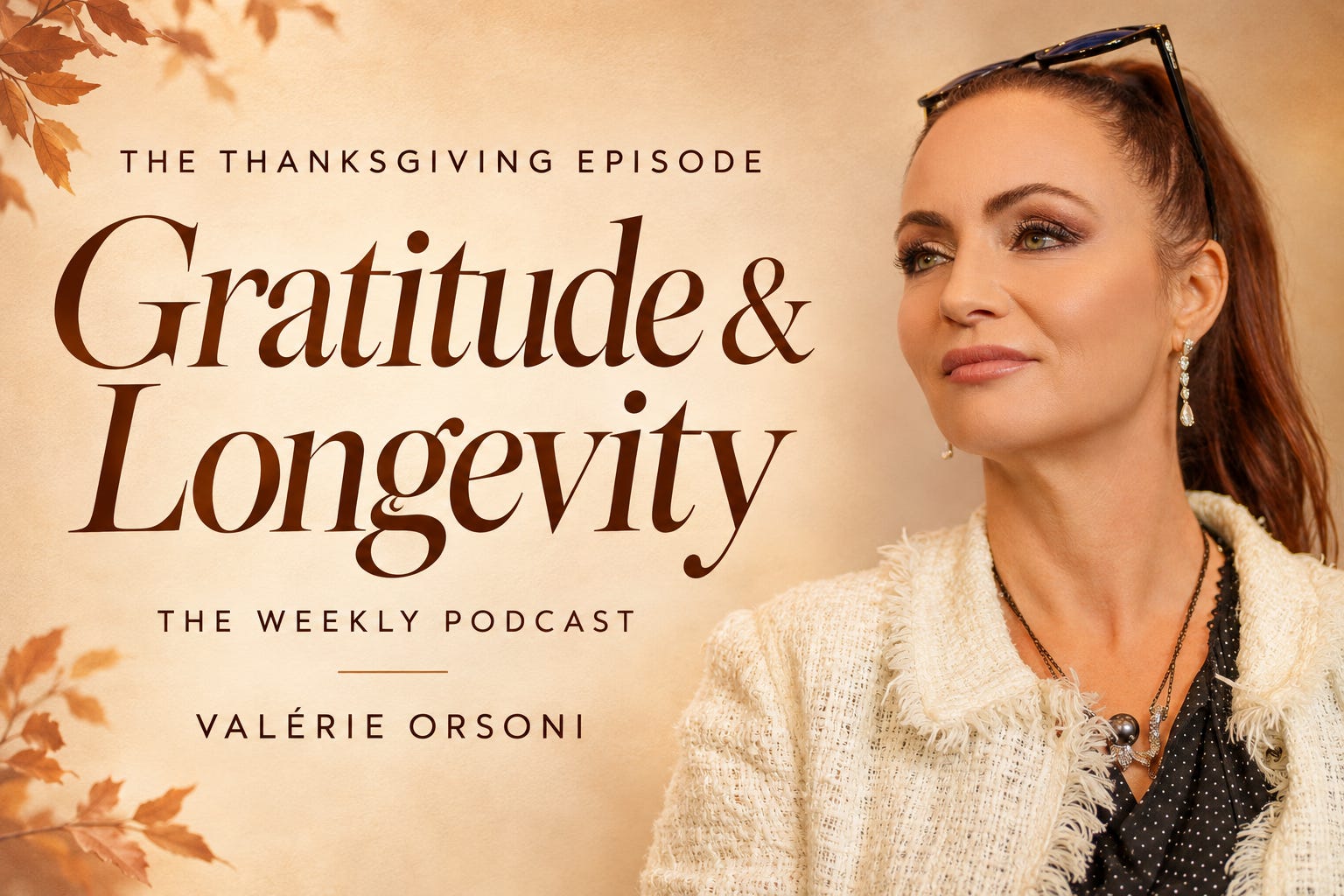
Gratitude: The Free Longevity Biohack Hiding in Your Thanksgiving
Every November, we spend weeks planning the turkey, the stuffing and the pie, and about two minutes on the real point of Thanksgiving: gratitude.
This week I flipped it. In my new audio episode, I treat gratitude like any other biohack. What does it do to your brain, your hormones, your heart? Does it really help you live longer? And how do you turn a holiday dinner into a longevity day instead of a food coma?
Here are the highlights. For the full story, and a short guided practice at the end, listen to the episode.
What the science says
Grateful people may live longer. In 2024, Harvard researchers followed 49,275 older nurses. The most grateful third had a 9% lower risk of death from any cause between 2016 and 2019, and roughly 15% lower cardiovascular mortality. That held even after accounting for health, lifestyle, social life and depression. It’s an association, not proof, but it fits the biology below.
Gratitude leaves a mark on your brain. Brain scans show gratitude activates the medial prefrontal cortex and the dopamine-rich reward system. In one study, people who wrote just three gratitude letters still showed stronger gratitude-related brain activity three months later. Most never sent the letters. Writing was enough.
It works on your stress and bonding hormones. Small studies link appreciation practices to lower cortisol and higher DHEA, and gratitude appears tied to the oxytocin system. Promising signals, not guarantees, so this is a great N=1 test if you track your labs.
It calms the heart and inflammation. In a pilot trial with heart patients, eight weeks of gratitude journaling lowered inflammatory markers, and HRV rose during the practice. Grateful people also tend to sleep better, partly because fewer worries run through their head at bedtime.
No prescription, no battery, no subscription. Gratitude may be the most underrated biohack there is.
My Thanksgiving table biohacks
Upgrade the gratitude round. Skip “I’m thankful for my family.” Name one person and one specific thing they did, and say it to them.
Choose connection over perfection. Strong relationships are linked to about 50% higher odds of survival. The conversation matters more than the stuffing.
Forget the tryptophan myth. Turkey isn’t what makes you sleepy. The size of the meal, the sugar and the alcohol are.
Eat in the right order. Vegetables and protein first, starches and pie last, for a flatter glucose curve.
Take a gratitude walk. 10 to 15 minutes after the meal, with someone, talking about what went well this year.
Protect your sleep. Finish eating three hours before bed and swap scrolling for two minutes of gratitude.
Be real. Gratitude isn’t pretending everything is perfect. It can sit right next to a hard year.
Try it: the 7-day gratitude protocol
Five minutes a day, maximum.
Measure. Note your morning HRV, sleep score or stress level from 1 to 10.
Three good things. At bedtime, write three things that went well and why. On paper.
Gratitude plus coherence. Hand on heart, breathe at about six breaths per minute, and hold a grateful memory for 3 to 5 minutes.
The letter. Write one page to someone you never properly thanked. Sending it is optional.
Say it out loud. Thank three people directly, with a real sentence.
Thank your body. List three things it did for you this week.
Measure again. Compare with Day 1, then pick a rhythm you’ll keep. Research suggests once a week can beat forcing it every day.
Gratitude is a powerful complement, but not a treatment for depression or anxiety. If you’re struggling, please talk to a professional.
Listen to the full episode
In the episode I go deeper into each study, share how I add gratitude to my daily cardiac coherence, and guide you through a short practice to end on.
And tell me: what is the one specific thing you’re most grateful for this year? I read every message.
Happy Thanksgiving.
References and sources after my signature.
Valerie Orsoni
Biohacker since 1998 | Longevity Expert
University of Hartford Hall of Fame
Top 50 Longevity Leaders (by Lifespanning Magazine)
Explorer: Skied to the South Pole, Climbed 45 peaks over 16k ft
Instagram : Valerie Orsoni
My fave brands + super promo codes here ==> ValerieOrsoni.com
My made-in-the-usa, clean, no fillers supplement line ==> ZellNova
PRIVATE LONGEVITY COACHING : Go to ABOUT page on ValBiohacker.com
🎙 Younger — San Francisco (Jan. 11-12, 2027)
🎙 Biohackers World Conference — Miami (Jan. 16-17, 2027)
🎙 Biohackers World Conference — San Francisco (Mar 13-14, 2027)
🎙 Longevity Show — Istanbul, Turkey (April 3-5, 2027)
🎙 Pulse Congress — Liège, Belgium (May 20, 2027)
🎙 Biohackers World Conference — Chicago (May 8-9, 2027)
🎙 Life Summit — Berlin, Germany (May 20-21, 2027)
🎙 Corsica Longevity Week — Corsica (June 12-19, 2027)
🎙 Mongolia Exclusive 2-week Longevity Experience - Mongolia (July 10-26, 2027)
🎙 Biohackers World Conference — New York (Sept 18-19, 2027)
Sources
Chen et al., JAMA Psychiatry, 2024: Gratitude and mortality among older US female nurses
Kini et al., NeuroImage, 2016: The effects of gratitude expression on neural activity
Karns et al., Frontiers in Human Neuroscience, 2017: Gratitude and the brain’s reward response
Redwine et al., Psychosomatic Medicine, 2016: Gratitude journaling, HRV and inflammation
McCraty et al., 1998: appreciation, cortisol and DHEA
Algoe and Way, 2014: gratitude and the oxytocin system
Wood et al., 2009: gratitude and sleep
Holt-Lunstad et al., PLoS Medicine, 2010: social relationships and mortality
Lyubomirsky et al., 2005: how often to practice


